Por Fin, Alivio Real del Ojo Seco
¿Las gotas no funcionan? No está solo. Tratamos la causa raíz de su ojo seco, no solo los síntomas. Nuestros tratamientos avanzados brindan alivio duradero para que pueda ver y sentirse mejor.
¿Por Qué Sus Ojos Se Sienten Secos?
El ojo seco no se trata solo de no producir suficientes lágrimas. La mayoría de los casos (86%) son causados por glándulas sebáceas bloqueadas en los párpados.
Aqueous Deficient
Your lacrimal glands don't produce enough tears. The tear film is too thin, causing rapid evaporation and irritation.
- Sjögren's syndrome (autoimmune)
- Age-related gland decline
- Medications (antihistamines, antidepressants)
- Diabetes
- Radiation to head/neck
10-15% of dry eye cases
Evaporative (MGD)
Tears evaporate too quickly because the oil layer is deficient. Meibomian gland dysfunction is the #1 cause.
- MGD — 86% of dry eye cases
- Blepharitis / lid inflammation
- Low blink rate (screens)
- Contact lens wear
- Environment (wind, AC, heating)
Most common — 86% involves MGD
Learn about MGD →Mixed Dry Eye
Most patients have both aqueous deficiency and evaporative dysfunction. A single treatment rarely works — you need a multi-targeted approach.
- Combined aqueous + evaporative
- Hormonal changes (menopause)
- Goblet cell deficiency (mucin layer)
- Chronic untreated dry eye
80%+ of patients
Neuropathic Dry Eye
Corneal nerve damage reduces sensation and disrupts the tear reflex. Eyes feel dry but may show minimal clinical signs — often missed on standard exams.
- Post-LASIK / post-PRK
- Post-cataract surgery
- Herpes simplex/zoster keratitis
- Diabetes (neuropathy)
- Neurotrophic keratitis
Often undiagnosed
Post-LASIK dry eye →Classification based on TFOS DEWS II Report (Craig et al., The Ocular Surface, 2017) and AAO Dry Eye Syndrome PPP 2024
MGDx Meibography: See Your Glands Before They're Gone
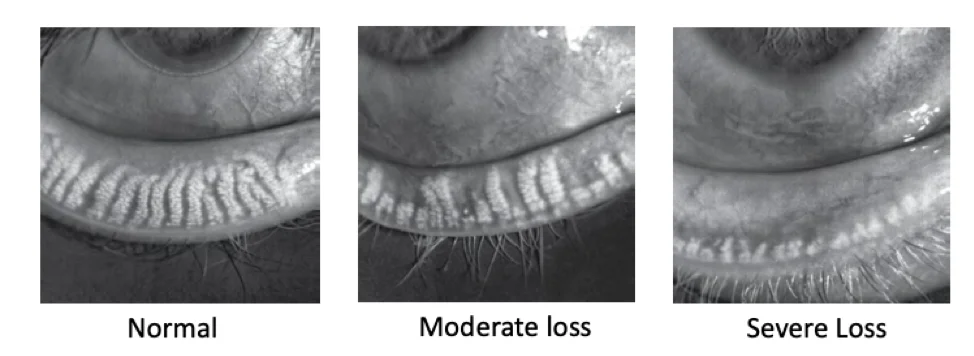
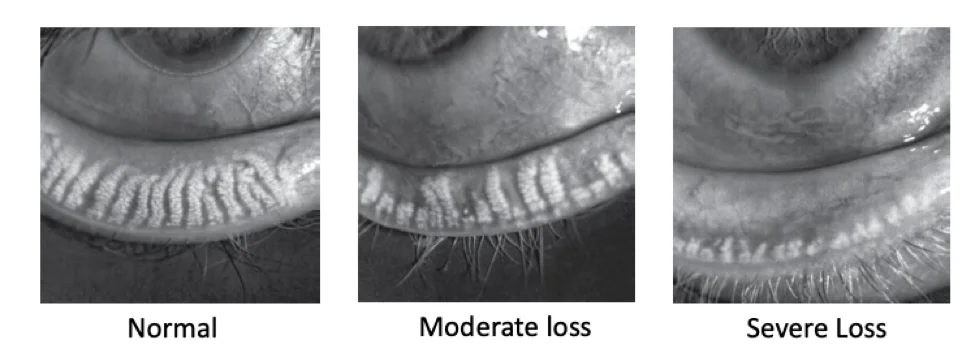
We use MGDx meibography — an advanced infrared imaging system that photographs your meibomian glands through the eyelid. This non-invasive scan reveals the exact structure, health, and atrophy level of each gland in seconds.
Why it matters: meibomian glands cannot regenerate once lost. By the time you feel symptoms, significant gland dropout may have already occurred. Meibography catches atrophy early — often years before symptoms appear — so treatment can begin before permanent damage.
- Visualizes all meibomian glands in both upper and lower lids
- Grades gland loss from Stage 1 (mild) to Stage 4 (severe atrophy)
- Tracks treatment progress over time with before/after comparison
- Painless, non-contact — takes less than 60 seconds
Included in every dry eye evaluation at EyeCare Center OC.
Identificamos Su Causa Raíz
Nuestra evaluación integral del ojo seco utiliza imágenes avanzadas para ver sus glándulas de Meibomio, medir la calidad de las lágrimas y determinar exactamente por qué sus ojos están secos, para tratar la causa y no solo los síntomas.
Severity-Based Treatment Approach
Treatment intensity matches your disease severity. We start conservative and escalate based on your response — following the AAO Preferred Practice Pattern guidelines.
Symptoms
- Occasional dryness after screen use
- Mild burning or grittiness
- Symptoms resolve with rest
- Intermittent blurred vision
Treatment
- Preservative-free artificial tears
- Warm compresses + lid massage (2x daily)
- Omega-3 supplements (2,000–3,000mg)
- Screen breaks + humidifier
Symptoms
- Daily discomfort affecting work
- Redness and light sensitivity
- OTC drops not helping
- Blurred vision that fluctuates
Treatment
Everything in Mild, PLUS:
- Rx drops (Restasis, Xiidra, Cequa)
- IPL treatment
- Low-Level Light Therapy (LLLT)
- Punctal plugs to retain tears
- BlephEx lid debridement
Symptoms
- Constant pain and burning
- Corneal damage or erosions
- Unable to wear contacts
- Significant vision impairment
Treatment
Everything in Moderate, PLUS:
- Intensified IPL series + maintenance
- Autologous serum tears
- Scleral lenses for surface protection
- Amniotic membrane therapy
- Meibomian gland probing
Even mild symptoms deserve evaluation. Meibomian glands atrophy silently — by the time symptoms become moderate, significant gland loss may have already occurred. Early intervention preserves gland function.
Treatment approach based on AAO Dry Eye Syndrome Preferred Practice Pattern 2024
Tratamientos Avanzados para el Ojo Seco
Ofrecemos toda la gama moderna, desde un ejercicio de parpadeo gratuito hasta las recetas aprobadas por la FDA más recientes y los procedimientos en consulta, para tratar la causa real de sus síntomas.
Terapia IPL
Luz Pulsada Intensa
Tratamiento basado en luz que reduce la inflamación, elimina bacterias y derrite el aceite obstruido en sus glándulas. Serie de 4 tratamientos para resultados óptimos.
- Trata la causa raíz de la DMG
- Resultados duraderos
- Sin tiempo de recuperación
BlephEx
Desbridamiento del Borde Palpebral
Limpieza de grado médico de los bordes de sus párpados para eliminar residuos, bacterias y biopelícula que contribuyen a la inflamación.
- Mejora inmediata
- Trata la blefaritis
- Procedimiento rápido
LLLT (Luz Roja)
Terapia de Luz de Baja Intensidad
Terapia de luz no invasiva que reduce la inflamación, estimula la reparación celular y ayuda a tratar los orzuelos sin cirugía.
- 100% no invasivo
- Trata chalaziones
- Reduce la inflamación
Expresión de Glándulas
Limpieza Manual
Expresión terapéutica de las glándulas de Meibomio para eliminar físicamente los bloqueos después del calentamiento. A menudo combinada con otros tratamientos.
- Resultados inmediatos
- Retroalimentación diagnóstica
- Complementa el calentamiento
Membrana Amniótica
Dispositivo de Reparación Ocular
Un disco transparente de tejido amniótico que se coloca sobre el ojo como un lente de contacto grande. Calma la inflamación y repara una córnea dañada en pocos días. Usamos dispositivos como Prokera para enfermedad grave de la superficie.
- Repara la córnea dañada
- Fuerte efecto antiinflamatorio
- Se lleva unos días y se retira
Lentes Esclerales para Ojo Seco
Depósito de Líquido Todo el Día
Un lente grande que se arquea sobre la córnea y mantiene una reserva de solución salina estéril contra ella todo el día. Para el ojo seco grave suele ser lo único que da comodidad de la mañana a la noche.
- Humedad constante más de 10 horas
- Además mejora la visión
- Para ojo seco grave o resistente
Entrenamiento del Parpadeo
Ejercicios de Parpadeo Completo
El trabajo con pantallas reduce el parpadeo a menos de la mitad, y muchos parpadeos nunca cierran por completo. Las glándulas inferiores entonces nunca liberan su aceite. Le enseñamos un ejercicio diario corto que restaura el parpadeo completo.
- Gratis, se hace en casa
- Trata la sequedad por pantallas
- Mejora todos los demás tratamientos
Miebo
Perfluorohexiloctano
Gota aprobada por la FDA que forma una capa fina sobre la película lagrimal y frena la evaporación. Trata la causa del ojo seco evaporativo en lugar de solo añadir humedad.
- Aprobado por la FDA en 2023
- Sin conservantes ni agua
- Diseñado para ojo seco evaporativo
Tyrvaya
Aerosol Nasal para Lágrimas
Un aerosol nasal, no una gota. Estimula la vía nerviosa que produce sus propias lágrimas naturales, para que forme una película lagrimal completa en lugar de una artificial.
- No entra nada en el ojo
- Produce sus propias lágrimas
- Buena opción si las gotas arden
XDEMVY
Blefaritis por Demodex
La primera gota aprobada por la FDA que elimina los ácaros Demodex. Estos ácaros viven en la raíz de las pestañas y causan muchos casos persistentes de párpados con costras y picor que la limpieza sola nunca resuelve.
- Elimina el ácaro, no solo los restos
- Ciclo fijo de 6 semanas
- Se combina con la limpieza BlephEx
Lágrimas de Suero Autólogo
Hechas de Su Propia Sangre
Gotas preparadas con el suero de su propia sangre. Contienen los factores de crecimiento y las vitaminas que tienen las lágrimas naturales y no tienen las artificiales. Las reservamos para casos graves que las gotas normales no controlan.
- Para ojo seco grave y resistente
- Ayuda a sanar la superficie ocular
- Sin conservantes
Gotas Personalizadas
Terapia con Receta
Cuando la inflamación causa su ojo seco, recetamos gotas como Restasis, Xiidra o Cequa para calmarla y aumentar su propia producción de lágrimas.
- Uso diario en casa
- Trata la deficiencia acuosa
- Reduce la inflamación
Especialistas en Disfunción de Glándulas de Meibomio
La DMG es la causa #1 del ojo seco. Cuando sus glándulas sebáceas se bloquean, sus lágrimas se evaporan demasiado rápido, dejando sus ojos secos, irritados e incómodos.
Do You Have MGD?
Meibomian glands cannot regenerate
Once glands atrophy from chronic blockage, they are lost permanently. This is why early, aggressive treatment is essential — not just warm compresses and drops.
Our MGD Treatment Protocol
We use a progressive treatment approach based on severity — starting with at-home therapies and advancing to in-office procedures when needed.
At-Home Foundation: Warm Compresses, Lid Massage & Omega-3
Every MGD treatment plan starts with consistent at-home care. Warm compresses (10 minutes, twice daily using a microwavable mask) soften the solidified oils in blocked meibomian glands. Immediately follow with gentle lid massage — pressing down on the upper lid and up on the lower lid toward the lash line to express the warmed oil.
High-dose omega-3 fatty acids (EPA/DHA, 2,000-3,000mg daily from re-esterified triglyceride form) are clinically recommended to improve meibum lipid quality and reduce eyelid inflammation. The Dry Eye Assessment and Management (DREAM) Study Group and subsequent meta-analyses confirm omega-3 supplementation improves tear breakup time and reduces ocular surface disease symptoms.
Important: Warm compresses alone provide only 20-40% improvement (Dell et al., 2017). While essential as a foundation, most patients with moderate-to-severe MGD require in-office treatments for meaningful, lasting relief.
Low-Level Light Therapy (LLLT) — Photobiomodulation
LLLT uses specific wavelengths of red and near-infrared light (590-700nm) delivered via the Marco Equinox mask to stimulate cellular energy production in the meibomian glands. It is 100% non-invasive, painless, and requires no numbing or recovery time.
How LLLT Works
- Photobiomodulation — light energy absorbed by cytochrome c oxidase in mitochondria increases ATP production, stimulating gland function
- Gentle heating — warms glands from inside out, liquefying thickened meibum without the discomfort of external heat
- Inflammation reduction — downregulates pro-inflammatory cytokines (IL-6, TNF-α) in the eyelid tissue
- Treats styes/chalazions — can resolve early-stage lid lumps without surgical incision
Clinical Evidence for LLLT
- Significant improvement in TBUT, OSDI scores, meibum quality, and tear meniscus height (Antwi et al., 2024)
- SPEED score decrease significantly greater with LLLT vs. IPL alone (Park et al., 2023)
- 95.6% of patients saw significant OSDI reduction with combined IPL+LLLT (Stonecipher et al., 2021)
- Meibum expressibility improved and maintained at final follow-up with LLLT alone (Fineide et al., 2025)
Our protocol: LLLT is used as both a standalone treatment for mild-moderate MGD and as a synergistic adjunct to IPL therapy. When combined with IPL, LLLT is performed immediately before or after the IPL session to maximize gland response.
IPL (Intense Pulsed Light) — The Gold Standard for MGD
Most EffectiveIPL is the most studied and most effective in-office treatment for meibomian gland dysfunction. Unlike LipiFlow, which only applies heat and pressure to express old oil, IPL treats the root cause of MGD — chronic inflammation.
Why IPL Is Superior to LipiFlow
- Inflammation control: IPL targets abnormal blood vessels (telangiectasia) along the lid margin that fuel chronic inflammation. By closing these vessels, IPL breaks the inflammatory cycle that causes gland obstruction.
- Bacterial & Demodex elimination: The light energy destroys bacteria and Demodex mites on the lid margin — both major contributors to posterior blepharitis and MGD.
- Meibum liquefaction: Heat from IPL pulses softens solidified meibum deep within the glands, restoring natural oil flow.
- Collagen remodeling: Stimulates fibroblast activity and new collagen formation in periocular tissue, improving overall lid health.
LipiFlow limitation: LipiFlow only applies vectored thermal pulsation to mechanically express blocked meibum. It does not address the underlying inflammation, bacteria, or vascular abnormalities that cause glands to re-block. This is why LipiFlow results often diminish within 6-12 months while IPL provides longer-lasting improvement.
IPL Treatment Schedule
Initial Series: 4 treatments
Spaced 2-4 weeks apart. Most patients notice improvement by session 3.
Maintenance: Every 6 months
After initial series, maintenance treatments every 6 months sustain results long-term.
Clinical Evidence
- 87% improvement in MGD signs after IPL series (Dell et al., 2017)
- IPL+MGX improved TBUT from 4.0s → 6.0s vs. MGX alone 3.8s → 4.5s (Hagen et al., 2022)
- IPL effective with or without expression (systematic review, 2024)
- IPL superior TBUT + SPEED improvement vs. LipiFlow in network meta-analysis (2025 meta-analysis)
- Safe, effective on upper and lower eyelids across multicenter study (Albietz et al., 2023)
Our recommendation: For moderate-to-severe MGD, we recommend a series of 4 IPL sessions combined with LLLT and meibomian gland expression, followed by maintenance every 6 months. This combined approach delivers the most comprehensive and longest-lasting relief.
IPL vs. LipiFlow: How They Compare
| Feature | IPL Therapy | LipiFlow |
|---|---|---|
| Mechanism | Anti-inflammatory + heat + bacterial elimination | Heat + mechanical pressure only |
| Treats inflammation | ||
| Kills bacteria/Demodex | ||
| Closes abnormal vessels | ||
| Expresses glands | ||
| Sessions needed | 4 initial + maintenance | 1 session (repeat if needed) |
| Duration of results | 6-12+ months with maintenance | 6-12 months (often diminishes) |
| TBUT improvement | Superior (meta-analysis 2025) | Significant |
Source: Network meta-analysis of 12 RCTs, 969 patients (PubMed, 2025)
Qué Esperar en Su Evaluación
Su primera visita dura entre 60 y 90 minutos: historia clínica detallada, cuestionarios de síntomas (SPEED, OSDI) y una serie de pruebas objetivas de la superficie ocular. Usted se va con:
- Un diagnóstico claro que nombra el o los subtipos de ojo seco que tiene
- Imágenes de meibografía que muestran la estructura de sus glándulas y cualquier daño
- Un plan de tratamiento escrito y por etapas: qué empezamos ahora, qué agregamos si los síntomas persisten y el plazo esperado de mejoría
- Expectativas realistas: el ojo seco por lo general se controla, no se cura; la mejoría se mide en semanas o meses
No sobrevendemos procedimientos en consultorio. Si su ojo seco es leve y es probable que responda a una rutina disciplinada en casa, eso es lo que recomendamos. IPL, LLLT y lentes esclerales se reservan para los pacientes que realmente los necesitan.
Comprendiendo el Tratamiento del Ojo Seco
El Dr. Bonakdar explica los últimos tratamientos para el ojo seco y cómo podemos ayudarle a encontrar alivio.

IPL for Dry Eye — Treating the cause of evaporative dry eye with light
Treating the cause of evaporative dry eye with light.

Treating Dry Eye — There is a lot that can be done
There is a lot that can be done.
Casos de Éxito en Ojo Seco
Pacientes reales que finalmente encontraron alivio al ojo seco crónico
Jennifer K.
Age 52
"I tried every drop on the market for years. After just 3 IPL treatments, I finally have relief. I can wear makeup again without my eyes burning!"
Outcome:
80% symptom reduction, returned to contact lens wear
Robert M.
Age 61
"Working from home was torture for my eyes. After treatment and some lifestyle changes Dr. B recommended, I can finally work comfortably again."
Outcome:
SPEED score improved from 18 to 5, able to work 8+ hours
Maria G.
Age 45
"My eyes would crust over every morning. Now I wake up with comfortable eyes. The IPL treatment was so easy and made such a difference!"
Outcome:
Morning crusting eliminated, TBUT improved from 3s to 9s
* Patient names abbreviated for privacy. Results may vary. Individual outcomes depend on various factors.
Preguntas Frecuentes
¿Por qué no me funcionan las gotas para los ojos?
La mayoría de las gotas de venta libre solo agregan humedad temporalmente; no abordan por qué sus ojos están secos. Si sus glándulas de Meibomio están bloqueadas (el caso del 86% de los pacientes con ojo seco), necesita tratamiento para limpiar esas glándulas. Eso es lo que hacen nuestros tratamientos avanzados como la IPL y la terapia de luz roja.
¿Qué es la IPL y cómo ayuda al ojo seco?
La IPL (Luz Pulsada Intensa) es un tratamiento basado en luz que actúa sobre los vasos sanguíneos y la inflamación alrededor de sus párpados. Reduce el enrojecimiento, mata bacterias incluyendo los ácaros Demodex, y ayuda a derretir el aceite engrosado en sus glándulas. La mayoría de los pacientes necesita 4 tratamientos con intervalos de 2-4 semanas.
¿Es doloroso el tratamiento IPL?
La mayoría de los pacientes describe la IPL como muy cómoda, como una sensación cálida en la piel. Aplicamos un gel refrescante y protectores sobre sus ojos. No hay tiempo de recuperación y puede retomar sus actividades normales de inmediato.
¿Cuánto duran los tratamientos para el ojo seco?
Los resultados varían según el tratamiento. La IPL generalmente brinda alivio durante 6-12 meses. Los tratamientos con receta como Miebo funcionan mientras los siga usando. Muchos pacientes mantienen sus resultados con tratamientos de mantenimiento periódicos y cuidados adecuados en casa.
¿Por qué usan IPL en lugar de LipiFlow?
LipiFlow aplica calor y presión desde el interior del párpado para exprimir las glándulas bloqueadas en una sola sesión. La IPL usa energía luminosa desde el exterior para reducir la inflamación que hace que las glándulas se bloqueen. Usamos IPL porque tratar esa inflamación es lo que hace que los resultados duren; el calor y la presión por sí solos se desvanecen cuando las glándulas se vuelven a bloquear.
¿Puedo usar lentes de contacto si tengo ojo seco?
¡Con frecuencia, sí! Una vez que tratamos su condición subyacente de ojo seco, muchos pacientes pueden retomar el uso cómodo de lentes de contacto. Para casos severos, las lentes especiales como las esclerales proporcionan un reservorio de humedad que mantiene el ojo hidratado todo el día.
¿Cuánto cuesta el tratamiento del ojo seco?
Los costos varían según el tratamiento. Una evaluación del ojo seco generalmente está cubierta por el seguro médico, pero el tratamiento IPL en sí es electivo y no está cubierto: suele costar $400-800 por sesión (paquetes disponibles). Aceptamos FSA/HSA y ofrecemos financiamiento a través de CareCredit.
¿Necesito una derivación para el tratamiento del ojo seco?
No se necesita derivación. Puede programar una evaluación de ojo seco directamente con nosotros. Realizaremos una evaluación integral y discutiremos todas las opciones de tratamiento con usted.
¿Qué causa la enfermedad del ojo seco?
El ojo seco tiene múltiples causas: disfunción de las glándulas de Meibomio (glándulas de aceite bloqueadas en los párpados), producción reducida de lágrimas, factores ambientales como el aire acondicionado y las pantallas, ciertos medicamentos y condiciones de salud subyacentes. Una evaluación integral identifica su causa específica para un tratamiento dirigido.
¿Puede el ojo seco dañar mi visión?
El ojo seco crónico puede afectar la calidad de la visión y, si es severo, dañar la superficie de la córnea. Sin tratamiento durante años, las glándulas de Meibomio bloqueadas también pueden atrofiarse, lo cual es permanente. Con el tratamiento adecuado la mayoría de los pacientes logra un alivio significativo y evita complicaciones a largo plazo; tratar temprano da mejores resultados.
Deje de Sufrir de Ojos Secos
No tiene que vivir con ojos ardientes e irritados. Programe su evaluación integral de ojo seco y descubra qué está causando realmente sus síntomas.
Schedule Your Dry Eye Treatment Consultation
Fill out the form below and our team will contact you to confirm your appointment. Or call us directly at (949) 323-3600
Lectura relacionada
Condiciones relacionadas
- Blepharitis
Blepharitis is inflammation of the eyelid margins — the strip of skin where your lashes grow. It makes the lids red, itchy and sore, and…
- Meibomian Gland Dysfunction (MGD)
Meibomian gland dysfunction is the most common cause of dry eye. You have about 25 to 30 tiny oil glands in each eyelid. Their oil forms…
- Conjunctivitis (Pink Eye)
Conjunctivitis, commonly known as pink eye, is an inflammation of the conjunctiva causing redness, itching, and discharge.
Servicios relacionados
- IPL Treatment for Dry Eye
Intense Pulsed Light (IPL) therapy for chronic dry eye and meibomian gland dysfunction. Long-lasting relief from dry, irritated eyes.
- Low-Level Light Therapy (LLLT)
Non-invasive photobiomodulation therapy to reduce inflammation and stimulate cellular repair in dry eye patients.
Artículos relacionados
- Dry Eye Syndrome: Why Over-the-Counter Drops Aren't Enough
Artificial tears not cutting it? Chronic dry eye has a root cause most drops miss. See how IPL and modern gland-targeted therapy actually fix the underlying…
- IPL Therapy: The Breakthrough Solution for Meibomian Gland Dysfunction
Dry eye drops never quite working? IPL therapy targets meibomian gland dysfunction at the source. Here's how it actually fixes the root cause of MGD.